

What Property Managers Need to Know About Exterior Building Inspections in 2026
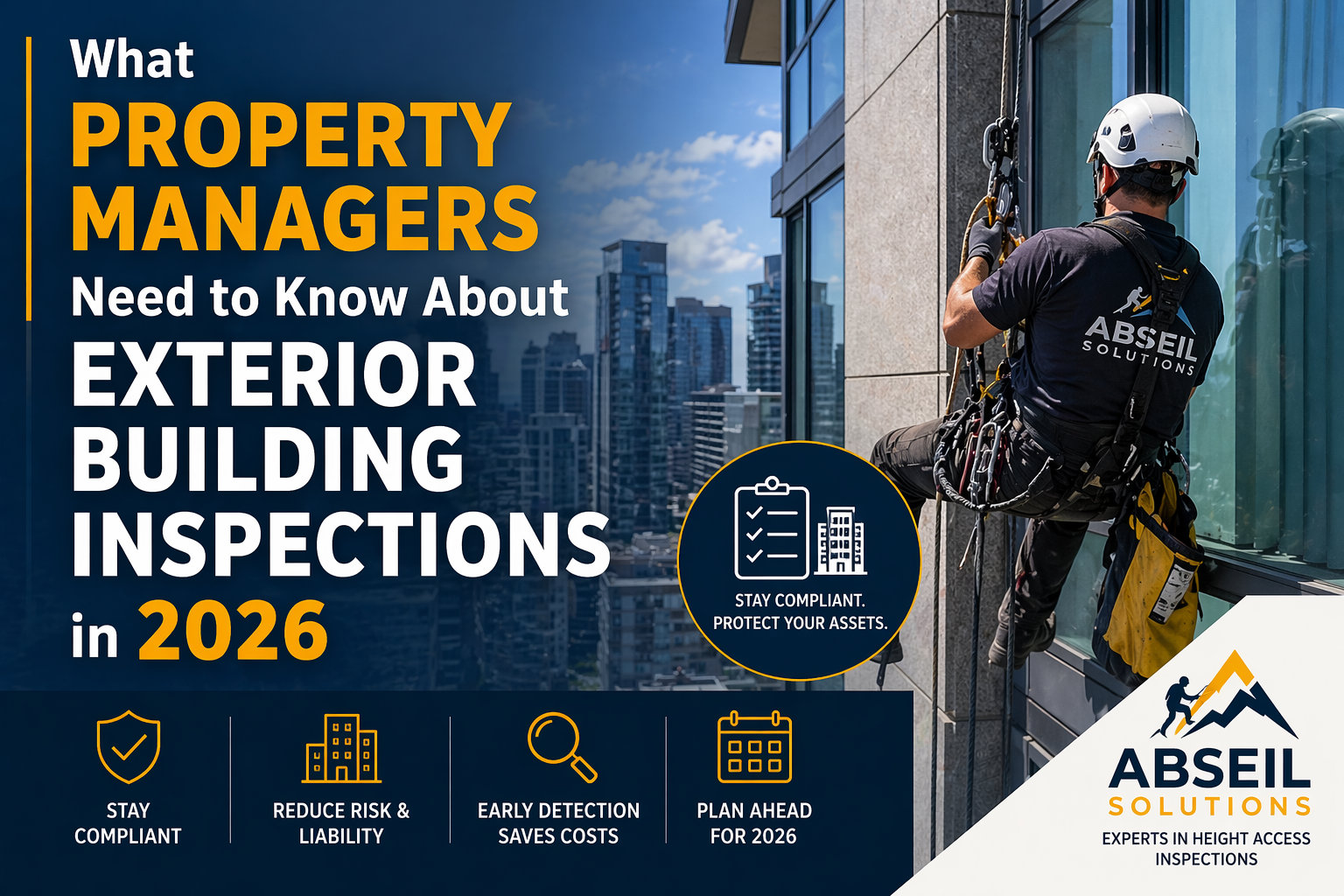
Most property managers only think about their building’s exterior after something goes wrong. A stain appears. A tenant complains. A piece of cladding shifts.
By that point, you’re not managing maintenance. You’re managing a crisis.
The reality is that the exterior of your building is working against you every single day — salt air, freeze-thaw cycles, UV exposure, bird damage, and water infiltration are relentless. What’s invisible today can become a liability claim, an insurance dispute, or a dangerous defect tomorrow.
This guide is for property managers and building owners who want to stay ahead of it — not react to it. Here’s exactly what you need to know about exterior inspections in 2026.
Not sure when your building was last properly inspected? Call Abseil Solutions at (902) 449-7580 for exterior building maintenance — most buildings booked within 48 hours.
Why Exterior Inspections Are Non-Negotiable
Your building’s facade isn’t cosmetic — it’s structural. Cladding, sealant joints, window perimeters, pressure-washed surfaces, and anchor points all degrade over time. When they fail, the consequences fall on you.
In the landmark Canadian case Winnipeg Condominium Corporation No. 36 v. Bird Construction Co., the Supreme Court of Canada established that building owners who discover defects posing a ‘real and substantial danger’ are obligated to address them. Critically, the Court ruled that liability for dangerous defects extends across the life of a building — not just during the original construction period.
That ruling has real teeth for property managers. If your facade has known deterioration and someone is injured, the question won’t be whether there was a defect. The question will be whether you knew — or should have known — and failed to act.
Key takeaway: A documented, proactive inspection program is your best legal and financial protection. It proves due diligence and catches defects before they become dangerous.
How Often Should Your Building’s Exterior Be Inspected?
This is the question most property managers get wrong — not because they don’t care, but because no one has given them a straight answer.
The international benchmark, established by ASTM E2270, recommends full exterior facade inspections at least every five years. But for many Canadian buildings — especially coastal properties like those in Halifax and Atlantic Canada — that interval is far too long.
Higher risk = more frequent inspections
Several factors accelerate exterior deterioration and should move your inspection schedule forward:
- Salt air and coastal exposure — Halifax’s harbour-adjacent buildings experience significantly faster corrosion and sealant degradation than inland structures
- Freeze-thaw cycles — Atlantic Canada’s climate means repeated freeze-thaw stress on caulking, concrete, and cladding every winter season
- Building age — structures over 20 years old with original sealant systems need closer monitoring
- Previous water infiltration — a building that has had any interior water staining or leaks requires urgent external review
- Bird activity — acidic droppings from pigeons and seagulls accelerate surface corrosion and can penetrate sealant joints
- Recent cladding, window, or facade work — any disturbance of the building envelope creates new joint vulnerability
As a general rule of thumb for Atlantic Canadian buildings:
Recommended schedule: High-exposure buildings (coastal, older stock, 10+ storeys): inspect annually. Standard commercial mid-rise: inspect every 2–3 years. Lower-risk newer builds: every 3–5 years in line with ASTM E2270 guidance.
What a Proper Exterior Inspection Actually Covers
Not all inspections are equal. A visual walkthrough from the ground is not a facade inspection. A proper exterior inspection requires close-up, hands-on access to the building’s envelope — and that means getting technicians onto the facade itself.
Here’s what a thorough inspection should assess:
Cladding and facade panels
- Visible cracking, delamination, or movement
- Corrosion at fixing points and brackets
- Gaps between panels or at building transitions
- Impact damage, staining, and surface deterioration
Sealant and caulking joints
- Adhesion failure — sealant pulling away from substrate
- Cracking or hardening due to UV and thermal cycling
- Compression or extension beyond designed tolerances
- Water staining below joint lines indicating active infiltration
Window and glazing perimeters
- Failed gaskets or perimeter seals
- Condensation channels and drainage functionality
- Frame integrity and anchor point condition
Roof-to-wall transitions and penetrations
- Flashing integrity and drainage clearance
- Mechanical penetration seals and their condition
- Parapet walls and coping stone condition
Anchor and rigging points
- Certification status of existing roof anchors
- Condition of any BMU (Building Maintenance Unit) rails or davit systems
- Suitability for rope access work
Why this matters: Finding a failed sealant joint during an inspection costs a fraction of what it costs once water has penetrated the wall assembly, caused mold growth, damaged interior finishes, or triggered a tenant dispute.
Why Rope Access is the Smarter Choice for Facade Inspections
There are three primary ways to access a building’s exterior for inspection: scaffolding, aerial lifts (boom lifts), and rope access. For the vast majority of mid- to high-rise buildings, rope access is the clear winner — and the cost difference is not subtle.
The cost gap is significant
Scaffolding for a mid-rise building typically runs $20,000–$35,000 or more before a single inspection has been performed — and that’s before dismantling costs, permit fees, and the weeks of ground-level disruption it causes. For taller structures, the figure climbs past $100,000.
Rope access inspection by an IRATA-certified team requires a fraction of that investment. There is no ground equipment, no permit for sidewalk closure, no weeks-long setup. In most cases, an IRATA team can mobilise, access the building, and complete an inspection in a fraction of the time.
Rope access is safer than scaffolding
This surprises most people. IRATA — the Industrial Rope Access Trade Association — reports that rope access incidents occur at a rate of under 0.2 per 100,000 working hours. That is among the lowest of any at-height work method in the construction and maintenance industry.
Every IRATA-certified technician operates on a dual-rope system: one working line and one independent safety backup, each anchored separately. If any component fails, the second system holds. Scaffolding, by contrast, introduces risks from improper erection, overloading, and weather instability.
Zero disruption to your building and tenants
This is where rope access wins decisively for occupied commercial and residential buildings. A scaffold occupies the footprint around your building for weeks — blocking pedestrian access, parking, deliveries, and ground-floor retail. Rope access technicians descend from the roof. Your tenants often don’t know they’re there until they notice the work is done.
Real project: At 44-46 Portland Street in Dartmouth, Abseil Solutions completed a three-week facade cleaning and exterior maintenance program via rope access. Zero disruption to ground-floor tenants. No permits for sidewalk closure. No scaffolding setup delays.
Get a free facade inspection quote from our IRATA-led team — most buildings receive a detailed quote within 24-48 hours. Call (902) 449-7580 or email info@abseilsolutions.ca
What to Demand from Any Inspection Contractor
Before you authorise any company to inspect or work on your building’s exterior, there are non-negotiable requirements you should verify. This protects you, your tenants, and your insurance position.
IRATA certification — not optional
IRATA is the global standard for rope access safety. IRATA-certified technicians have completed formal, assessed training and are classified at Level 1, 2, or 3 — with Level 3 being the most senior, capable of supervising and conducting rescues. Demand that your contractor provides proof of current IRATA certification for every technician who will access your building.
Be wary of contractors who offer vague references to ‘training’ without providing specific certification documentation. In a liability situation, this distinction matters enormously.
A documented safety management system
A credible rope access contractor should have a written Safety Management System (SMS) — not a verbal promise. This should include site-specific risk assessments, method statements, rescue plans, and equipment inspection logs for every project.
Abseil Solutions maintains a comprehensive Safety Management System and has maintained a zero lost-time incident record across all projects to date.
Proof of insurance
Verify that your contractor carries adequate general liability insurance for at-height work. Request a certificate of insurance naming your property and confirm coverage limits are appropriate for your building’s value.
A written inspection report
The output of an inspection should be a documented report with photographs, condition assessments for each facade zone, and clear recommendations prioritised by urgency. A verbal debrief is not a record. A written report is.
Warning Signs Your Building Needs Attention Now
Don’t wait for a scheduled inspection if you’re seeing any of the following. These are active signals that your building’s exterior is failing:
- Water staining on interior walls or ceiling, particularly near windows or exterior walls
- Visible cracks, gaps, or separations in sealant or caulking joints
- Efflorescence — white salt deposits on masonry or concrete indicating water movement through the wall
- Spalling or delamination of concrete, brick, or cladding panels
- Bird nesting or heavy droppings on ledges, parapets, or mechanical equipment
- Rust staining running down the facade from fixing points or lintels
- Any visible movement, bulging, or displacement of cladding panels
- Tenants reporting drafts, condensation, or unusual odours near exterior walls
Any one of these warrants a close-up inspection. Multiple signs mean the inspection should happen this week, not next quarter.
The Abseil Solutions Approach
Abseil Solutions is an IRATA-led rope access company serving commercial, residential, and institutional buildings across Nova Scotia and Atlantic Canada. Our IRATA team leads bring rigorous safety standards, full documentation, and a record of zero lost-time incidents to every project.
We’ve completed facade work on high-profile buildings including The Vuze in downtown Halifax — a 17-storey mixed-use building where we delivered facade cleaning, cladding installation support, and a certified bird-deterrent system via rope access, completing in 6 days what would have taken scaffolding 8–12 weeks.
When you work with Abseil Solutions, you receive:
- A written site assessment and inspection report with photographic documentation
- Full IRATA-certified team documentation available on request
- A Safety Management System and project-specific rescue plan before work begins
- No disruption to building operations, tenants, or ground-level access
- Free consultation and quotation within 24–48 hours for most properties
Ready to Get Your Building Inspected?
Proactive property management means not waiting for a tenant complaint, a leak, or a falling panel to tell you there’s a problem. An exterior inspection is one of the most cost-effective maintenance investments you can make — and with rope access, it costs far less than you think.
Contact Abseil Solutions today for a free consultation. We’ll assess your building, discuss your inspection needs, and provide a detailed quote within 24–48 hours.
Call (902) 449-7580 | Email info@abseilsolutions.ca | abseilsolutions.ca
Safe. Professional. Reliable.